Paseo Place apartment building pool
The Mystery of The Invisible DogThe pool at Paseo Place apartment building is the story’s decisive hiding place: beneath its clear water, the missing Carpathian Hound is concealed in plain sight, its gilt cord blending into the tiled floor. First presented as a well-lit courtyard amenity, the pool becomes a crime scene, a target of threatened maintenance, and finally the setting for the investigators’ discovery and a later attempted recovery.
Setting and Appearance
The pool lies at the centre of a flagstoned courtyard, reached through a gate beside a door. Chairs and tables surround it, while shrubs rim the court. When Jupiter Jones opens the gate, floodlights illuminate both the pool and the surrounding greenery. The arrangement makes the courtyard feel open and visible, but access is controlled by the gate, and the pool’s clear water conceals what rests at its bottom.
The investigators later wait beside the pool and take in its unusually decorative finish. Blue and gold tiles lie in a random pattern across the floor; Bob Andrews compares the design to the indoor pool at Hearst Castle in San Simeon. He reaches into the water and finds that it is heated. These details establish a space intended for use and comfort, not as an obvious hiding place. The visual irregularity of the tiles, however, will prove crucial: their mixed colors break up the line of a gold cord.
The courtyard also forms part of the boys’ movement through the building. After leaving Fenton Prentice, they go down the stairs, cross the court, and exit by a back passage that runs past a laundry and storeroom to an alley. The pool is therefore set amid shared residential routes and service spaces, rather than in an isolated or inaccessible location. Its ordinary place in the building helps explain how the investigators can return to it and keep watch.
A Shared Amenity Under Strain
The pool’s everyday role remains visible during the investigation. As the boys sit beside it, a grey cat enters the courtyard with a tawny-haired man. The man goes to his apartment, returns with food, and crouches while the cat eats on the flagstones. This small domestic routine unfolds in the same courtyard where the search is under way, placing the mystery against the unremarkable rhythms of apartment life.
The pool’s use also connects it to the danger surrounding Gwen Chalmers. When Mrs Bortz comes outside, she notes that Gwen is the only person using the pool in the cold weather and that Gwen will be unable to swim for several days. She proposes draining and cleaning it while Gwen is away, saying that it is overdue for a proper cleaning. Her practical concern about maintenance acquires a different significance when Jupiter considers why anyone would poison Gwen: one possible connection is her nightly swimming. The pool is not just scenery but a routine that links a resident to the hidden object and to the threats being investigated.
The Hound Hidden in the Tiles
Jupiter identifies the pool as the hiding place after connecting the search for a crystal dog concealed in plain sight with the glass knife in a water pitcher. Bob immediately recognizes the implication: the Hound is in the pool. Jupiter proposes retrieving it before the planned ransom the following day, reasoning that the building is empty except for the investigators. The discovery depends on looking again at a familiar feature of the courtyard rather than searching for an elaborate secret compartment.
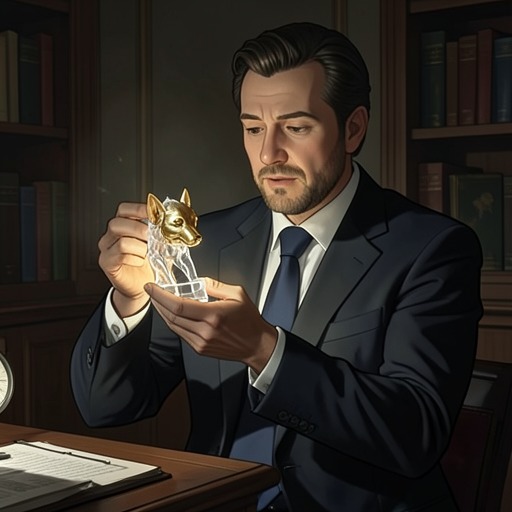
Jupiter enters the shallow end wearing only his shorts, then wades toward the deep end while scanning the blue-and-gold floor. When the water reaches his chin, he ducks beneath the surface, sinks, and propels himself forward just above the tiles. He reaches for something and rises holding an object with a string dangling from it. Fenton Prentice recognizes the sculpture as the Hound. It is a roughly six-inch figure of a heavily muscled dog, with a square head, gold-rimmed round eyes, gold flecks of froth on its crystal jowls, and a human skull between its feet. A long gilt cord is tied around its middle.
The cord explains the concealment. Jupiter reconstructs a simple method: the burglar lowered the Hound by the cord until it touched the pool floor, then let go. Against the randomly arranged blue and gold tiles, the gold cord was hard to see. The thief did not need to enter the water; the pool itself supplied a hiding place whose patterned surface defeated a casual search. The contrast is central to the object’s concealment: clear water seems to promise visibility, yet the Hound and its cord merge with what is already in view.
A Hiding Place Becomes a Search Ground
After the Hound is recovered, Jupiter asks Prentice for it back, and the pool’s role shifts from concealment to surveillance. Later, the investigators see a shadowy figure move silently toward the shallow end, enter the water with barely a ripple, and dive. A waterproof flashlight beam sweeps across the bottom. A hand reaches into its light and closes around the transparent Carpathian Hound. The sequence echoes the earlier recovery but reverses its direction: the object has been found, yet someone has come back into the pool to take it.
The pool consequently anchors several stages of the mystery without ceasing to be an ordinary apartment amenity. Its lighted courtyard setting permits observation; its heated water and tiled floor mark it as a place residents use; and its floor pattern makes a gold cord nearly disappear. Mrs Bortz’s proposed cleaning threatens to disturb the hiding place, while Jupiter’s underwater search exposes it. The pool’s significance lies in that reversal: what appears open and inspectable proves capable of hiding the story’s most important object in plain sight.